

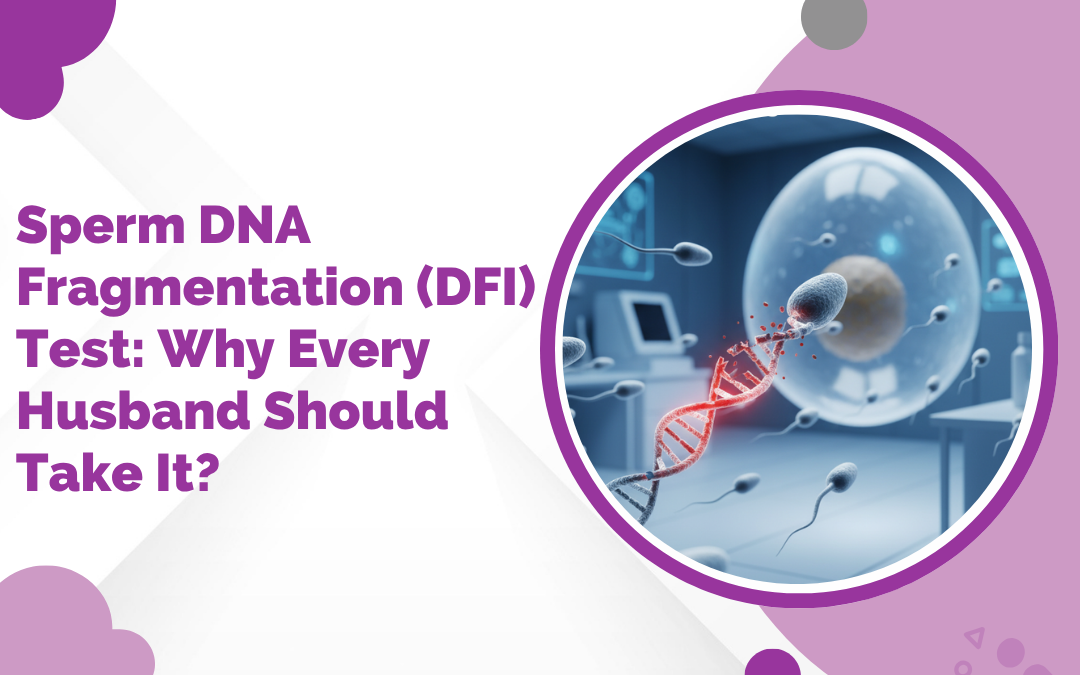
A Sperm DNA Fragmentation Index (DFI) test measures damage to the genetic material within sperm cells, serving as a diagnostic tool for male infertility, recurrent IVF failures, or miscarriages. High DFI, often caused by oxidative stress or varicocele, indicates greater than 30% damaged sperm, which impacts fertilization. Standard semen analysis checks sperm count, motility, and morphology but says nothing about whether the DNA inside those sperm is intact, and a man whose report looks completely normal on every conventional parameter can carry a DFI above 30 percent that explains his partner’s unexplained infertility, their repeated IVF failures, or her recurrent miscarriages.
According to Dr. Manisha Mehta, IVF Doctor in India, “The number of couples I have seen where the wife underwent hysteroscopy, laparoscopy, ERA testing, immune panels, and three IVF cycles before anyone thought to check her husband’s sperm DNA fragmentation is far higher than it should be, because the basic semen analysis came back normal and everyone assumed that meant the male factor had been ruled out when it had barely been investigated.”
What Does the DFI Test Actually Reveal That Standard Analysis Misses?
A semen report showing 40 million sperm with decent motility and acceptable morphology tells the doctor that the factory is producing enough units that move and look right, but it says absolutely nothing about whether the genetic blueprint packed inside each one is intact or shredded, and the gap between those two pieces of information is where hundreds of couples in every fertility clinic sit with the label “unexplained” attached to their file when the explanation was never actually looked for.
- Normal report, damaged cargo: A review of 14 studies found men with DFI above 30 percent had significantly worse pregnancy and live birth rates even when every standard semen parameter sat within the WHO normal range, which means the fertility clinic was running the wife through laparoscopy, hysteroscopy, ERA testing, and multiple IVF cycles while the husband’s single basic semen report sat unchallenged in the file, its limitations never acknowledged and the test that would have revealed the actual problem never ordered.
- Blastocysts that stall without explanation: ICSI data shows men with DFI above 30 percent produce fewer blastocysts than men below that threshold from the same number of fertilised eggs, and the embryologist watching embryos arrest on day 3 or 4 attributes it to “poor embryo quality” without realising the paternal DNA was fragmented before the sperm ever entered the egg, a cause that standard embryology assessment cannot see and standard semen analysis was never designed to detect.
- Positive tests that end in loss every time: Recurrent miscarriage after IVF in couples where the embryo looked good and the lining was ready correlates with elevated male DFI in published data, because fragmented paternal DNA allows fertilisation and early division to proceed normally but triggers developmental collapse once the embryo’s own genome activates around day 3 to 5, which is why the pregnancy test comes back positive and the ultrasound a few weeks later shows the heartbeat has stopped, a pattern that repeats cycle after cycle until someone checks the one variable that nobody thought to measure.
- The unexplained label hiding an untested diagnosis: When both partners test normal on conventional investigations and the couple gets told their infertility has no identifiable cause, DFI above 30 percent is present in a disproportionate number of those men according to published research, which does not mean every unexplained case is a DFI case but it does mean that calling something unexplained before ordering the test that would explain it is a diagnostic shortcut the couple is paying for with their time, money, and emotional reserves.
Women undergoing IVF treatment in India whose cycles produce good eggs but poor embryos should ask whether their partner’s DFI has been checked, because a normal semen analysis in the file does not mean the male factor investigation is complete.
What Can Actually Be Done If the DFI Comes Back High?
High DFI is one of the few fertility diagnoses where the 74-day sperm production cycle works in the patient’s favour, because the sperm that will be used for retrieval 3 months from now does not exist yet and the conditions it develops under are still within the couple’s control, which makes this a situation where targeted intervention during the waiting period can genuinely change what the embryologist has to work with on the day that matters.
- The lifestyle changes that actually move the number: Quitting smoking, dropping alcohol, losing excess weight, switching from briefs to boxers, removing the laptop from the lap, and sleeping 7 to 8 hours consistently reduces testicular oxidative stress within one spermatogenesis cycle, and couples whose husbands made these changes and retested at 3 months have had their treatment plan downgraded from IVF-ICSI to IUI treatment because the sperm quality improvement was large enough to change the clinical recommendation entirely.
- Antioxidants as targeted damage control: CoQ10, vitamin C, vitamin E, selenium, and zinc taken together for 3 months typically reduce DFI by 5 to 15 percentage points, and for the man sitting at 28 percent whose threshold for significantly improved outcomes is 30 percent that incremental reduction crosses the line between borderline and acceptable in a way that supplements alone would not fix for someone starting at 45 percent but that makes a material difference for the patients in the grey zone.
- Shorter abstinence before the sample is counterintuitive but backed by data: Sperm sitting in the reproductive tract for 4 or 5 days accumulates more oxidative damage than sperm ejaculated after 1 to 2 days, and collecting the IVF sample after a shorter abstinence window produces sperm with measurably lower fragmentation even though the total count drops slightly, a trade-off that favours DNA quality over quantity in every clinical scenario where ICSI is being used because the embryologist needs one intact sperm per egg, not millions of damaged ones.
- Testicular sperm bypasses the damage zone entirely: For men whose DFI stays above 30 percent despite months of lifestyle and supplement intervention, sperm extracted directly from the testis via micro-TESE carries significantly lower DNA fragmentation than ejaculated sperm because the oxidative damage accumulates during transit through the epididymis rather than inside the testis itself, and using testicular sperm for ICSI in persistent high-DFI patients has shown improved embryo development and reduced miscarriage rates compared to using ejaculated sperm from the same man on the same day.
DFI testing costs 3,000 to 8,000 rupees in India, a fraction of what a single IVF cycle costs, and men managing NIL Sperm Count alongside repeated failure should ensure their partner’s DNA has been evaluated before assuming the problem sits entirely on their side of the equation. Any good IVF center in India includes DFI in the workup after unexplained failure or recurrent loss rather than running additional cycles on the assumption that a normal semen report means the husband has been adequately investigated.
Why Choose Dr. Manisha Mehta?
Dr. Manisha Mehta has ordered DFI testing in couples whose conventional workup produced no explanation for repeated failure across her 20-year career, and her 85% IVF success rate includes couples whose high DFI was identified, treated with 3 months of lifestyle and antioxidant intervention, and retested to produce embryos qualitatively different from anything their previous cycles had generated because the variable that was actually causing the failure had finally been identified and addressed. Recognised among the best IVF specialists in India for investigating male factor beyond the basic semen report, she treats the husband’s DNA integrity with the same diagnostic seriousness as the wife’s hormones, lining, and embryo quality.
Call Now: +91 91680 39000
Had IVF failures or miscarriages with “normal” semen analysis? Get a sperm DNA fragmentation test to find out whether hidden male factor damage is the missing piece of your diagnosis.
Frequently Asked Questions
What DFI level is considered problematic for fertility?
DFI below 15 percent is considered good, 15 to 30 percent is borderline with declining outcomes, and above 30 percent is associated with significantly lower pregnancy rates, poorer embryo development, and higher miscarriage risk.
Does a normal semen analysis mean my husband's sperm is fine?
A normal semen analysis only confirms adequate count, motility, and morphology, and says nothing about whether the DNA inside the sperm is intact, which is why DFI testing is necessary when conventional results look normal but fertility outcomes remain poor.
Can sperm DNA fragmentation be improved?
Lifestyle changes, antioxidant supplementation, varicocele repair, and shorter abstinence periods before sample collection can all reduce DFI, with most men showing measurable improvement within 3 months of consistent intervention.
Is DFI testing recommended by fertility guidelines?
AUA and EAU 2023 guidelines have acknowledged the importance of DFI, though ESHRE does not yet recommend routine testing, placing it in the category of clinically useful but not universally endorsed.
You deserve answers from a doctor who knows your case.
Whether you are worried about a symptom, overdue for a check-up
I am here, and I am listening.
Talk to Dr. Manisha Mehta. Book Your Consultation Today.
Medically Reviewed by

Dr. Manisha Mehta
Gynaecologist & Obstetrics Specialist,IVF Doctor in India
Specialisation: Minimally Invasive Gynaecological Surgery | Women’s Health | Post-Operative CareApex Hospital -Sirsa, Haryana | Serving Delhi NCR, Haryana & surrounding regions
Reference link:
- Lifestyle Factors and Male Fertility – National Institutes of Health
- WHO Laboratory Manual for Semen Analysis, 6th Edition – World Health Organization


evvp7u