
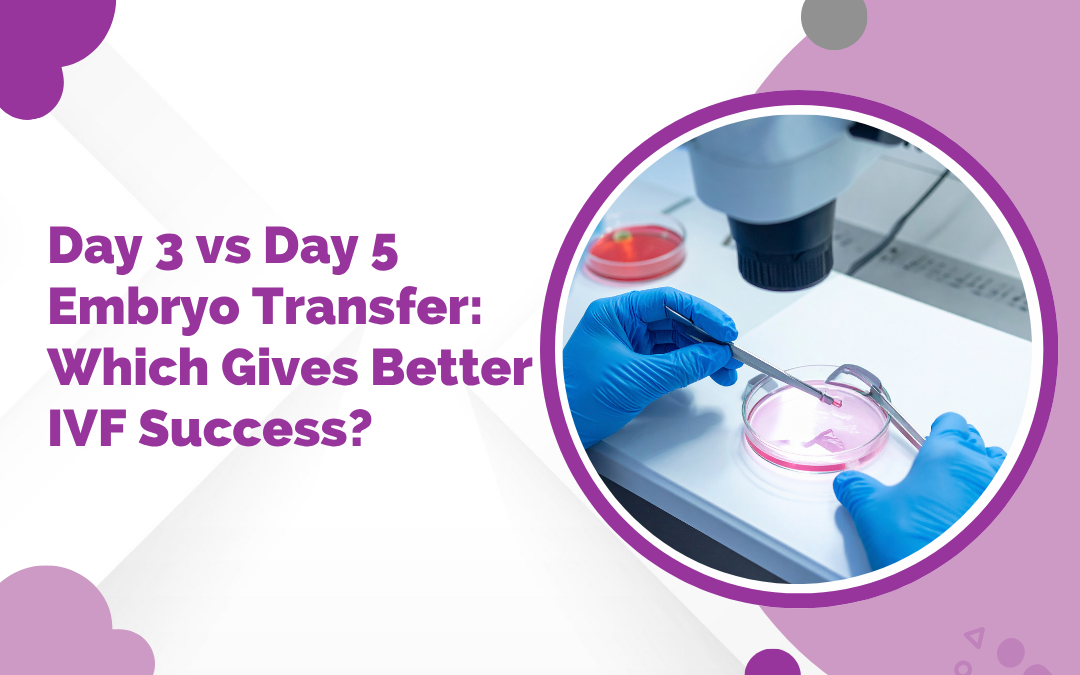
Day 5 blastocyst transfer has higher implantation rates than day 3 because the embryo has already proven it can develop for five days outside the body before anyone puts it back, but published randomised trials show live birth rates between the two are comparable, and the right choice depends on how many embryos a patient has, her age, whether genetic testing is needed, and frankly how good the lab is at keeping embryos alive that long without quietly losing them.
According to Dr. Manisha Mehta, IVF Doctor in India, “The day 3 versus day 5 debate sounds like it should have a straightforward answer by now, but it does not, because the decision that gives the best outcome for a 28-year-old with 12 embryos is completely wrong for a 39-year-old with 3, and treating it as a one-size question is where most of the confusion comes from.”
Why Do Most Clinics Now Prefer Day 5 Blastocyst Transfer?
The shift toward day 5 happened once laboratory culture media got good enough to keep embryos alive outside the body for five days without compromising them, and for patients producing 8 or 10 or 15 embryos per retrieval the advantages of waiting became hard to argue against, though applying that same logic to every patient regardless of embryo count is where the trouble starts.
- Natural selection in the lab: Ten fertilised eggs on day 1 become maybe 6 embryos by day 3 and 2 blastocysts by day 5, and the ones that survived five days of development outside the body have essentially auditioned for the transfer, proving they can divide and differentiate under pressure before they ever enter the uterus.
- Better implantation timing: After natural conception the fertilised egg reaches the uterus around day 5 as a blastocyst, and transferring at blastocyst stage replicates that synchronisation between embryo readiness and endometrial receptivity, a biological alignment that day 3 transfer does not offer because the embryo arrives before the uterus expects it.
- Single embryo transfer: Transferring one good blastocyst instead of hedging with two or three day 3 embryos brought twin pregnancy rates down dramatically, and twins sound like a bonus to couples who struggled to conceive but carry genuinely higher risks of preterm delivery, NICU stays, and maternal complications that nobody warns patients about enthusiastically enough.
- Genetic testing possible: PGT-A needs a biopsy from the trophectoderm and that structure only exists at blastocyst stage, so patients with recurrent miscarriage or women over 37 whose embryos carry a higher chromosomal abnormality risk simply cannot access genetic screening without waiting until day 5.
Women undergoing IVF treatment in India at centres with strong embryology labs now receive day 5 as the default, and for patients with enough embryos to absorb the attrition that happens between day 3 and day 5 the recommendation makes complete sense.
When Is Day 3 Transfer Actually the Better Choice?
Nobody writes up the case where a patient lost her only two embryos between day 3 and day 5 because the clinic ran a blanket blastocyst policy, but those cases sit in every fertility practice and the women who lived through them carry a specific kind of anger toward a protocol that was never built for someone with 3 embryos in the first place.
- Low embryo count: A patient sitting with 2 or 3 embryos on day 3 morning faces a genuine coin flip on whether any will be alive by day 5, and putting those embryos back into the uterus on day 3 gives them access to an environment no incubator on earth can replicate, a gamble that makes clinical sense when the alternative is potentially transferring nothing at all two days later.
- Previous lab attrition: Some patients watch their embryos arrest between day 3 and day 5 cycle after cycle, and after the second or third time the pattern is telling the clinical team something that protocol guidelines do not cover, that these particular embryos need the uterine environment earlier, and switching to day 3 has produced pregnancies in cases where repeated blastocyst attempts produced only disappointment.
- Older patients fewer eggs: A 39-year-old retrieving 4 eggs per cycle cannot afford to lose a single embryo to extended culture, and the published data showing comparable live birth rates between day 3 and day 5 exists specifically to protect this population from a protocol designed for patients with embryos to spare.
- Lab infrastructure: Not every IVF lab in India runs the culture systems, gas mixtures, and incubation technology needed for reliable extended culture, and a day 3 transfer at a clinic whose lab handles cleavage stage well produces better outcomes than a forced day 5 protocol in a lab that quietly loses embryos it should not be losing, a conversation patients stepping up from IUI treatment to IVF rarely think to have before committing to a centre.
The right answer changes with every patient and every cycle, and women managing PCOS and pregnancy who typically produce more eggs often suit day 5 while low responders benefit from day 3. Any good IVF center in India makes this call from the embryology report on transfer morning, not from a protocol sheet laminated to the wall six months ago.
Why Choose Dr. Manisha Mehta?
Dr. Manisha Mehta has spent 20 years making this exact call on transfer morning for thousands of patients, and her 85% IVF success rate reflects the fact that she looks at the embryology report in front of her and decides from there rather than running every cycle on the same day 5 default because a guideline written for a different patient population said so. Recognised among the best IVF specialists in India for making embryology decisions at the bench rather than from the desk, she has transferred enough day 3 embryos in low-responder patients to know that the answer that sounds more advanced is not always the answer that works.
Call Now: +91 91680 39000
Preparing for IVF and want to understand whether day 3 or day 5 transfer is right for your situation? Get an embryology-informed consultation that matches transfer timing to your biology.
Frequently Asked Questions
Is day 5 transfer always better than day 3?
Higher implantation rates on paper but comparable live birth rates in trials, and for patients with 2 or 3 embryos day 3 avoids the risk of losing everything to extended culture.
How many embryos typically survive from day 3 to day 5?
Roughly 40 to 60 percent of day 3 embryos develop to blastocyst, meaning a patient with 6 embryos on day 3 might have 2 to 4 on day 5.
Can I do genetic testing with day 3 embryos?
PGT-A requires trophectoderm biopsy which only develops at blastocyst stage, so genetic testing is only available with day 5 or later embryos.
Does the IVF lab quality affect which day is better?
Absolutely, and a lab that cannot reliably culture to blastocyst stage will lose embryos that would have survived perfectly well in the uterus from day 3.
You deserve answers from a doctor who knows your case.
Whether you are worried about a symptom, overdue for a check-up
I am here, and I am listening.
Talk to Dr. Manisha Mehta. Book Your Consultation Today.
Medically Reviewed by

Dr. Manisha Mehta
Gynaecologist & Obstetrics Specialist,IVF Doctor in India
Specialisation: Minimally Invasive Gynaecological Surgery | Women’s Health | Post-Operative CareApex Hospital -Sirsa, Haryana | Serving Delhi NCR, Haryana & surrounding regions
Reference link:
- History of in vitro fertilization in India
https://www.ncbi.nlm.nih.gov/pmc/articles/PMC3657976/ - Assisted reproductive technology in India: current scenario
https://pubmed.ncbi.nlm.nih.gov/30386559/

Haha777game? Never heard of it before, but the name’s catchy! I assume they offer slots! Looks like a fun way to pass the time if you’re bored! haha777game
Jolibetph? Hmm, another online gaming site. Gotta be careful out there, make sure they’re licensed and all that before you deposit anything, just looking out for ya! Good luck! jolibetph
Ta777… yet another new one on the scene in the Philippines, could be great! Someone’s gotta try it and let us know. Just be careful out there! I love a good slot game! ta777
Phspin 77 seems to be popping up everywhere. Website looks alright, I’ll give it a shot. Maybe I’ll even get lucky, who knows? phspin 77
Looking for some Blackjack action… checking out 88clb8gq com on Blackjack88clb.com. Fingers crossed! 88clb8gq com.
Bola 828bet, man, this site is pretty smooth. I’ve seen some decent odds and the interface is actually really easy to use. Good stuff! Check it out for yourself: bola 828bet
Hey there, checked out winnerspincasino and it’s pretty cool. Got some unique spins I couldn’t find anywhere else. If you are looking for new thrills, you should try this out. winnerspincasino
Alright, Seubete… not bad, not bad. Decent interface and a good range of options. Worth taking a peek! Click here to see for yourself: seubete.
Netabetmx, huh? Pretty solid offering, good for a quick flutter. Easy to get around too. Give it a try! Try it here: netabetmx.