

You may have been told your cervix is weak. Or that your previous pregnancy losses happened in the second trimester without a clear explanation. Or maybe a vaginal cerclage has already failed. If you are planning your next pregnancy or even considering IVF, hearing about abdominal cerclage in Haryana can feel confusing and overwhelming. This procedure is often recommended when other options have not worked, and understanding whether it is right for you can make a real difference in your next pregnancy outcome.
Dr. Manisha Mehta one of the most trusted IVF Doctors in India, at Apex Hospital, Sirsa, and works with women who have complex cervical and pregnancy histories, and abdominal cerclage is one of the procedures she performs for patients who have run out of other options
“Most women who come to me asking about abdominal cerclage have already been through a lot. A second-trimester loss. A failed vaginal cerclage. A cervix that is too short or too scarred to support a standard stitch. They do not need more vague answers — they need a clear plan. That is what this is about.”
— Dr. Manisha Mehta, Gynaecologist & Obstetrics Specialist, Apex Hospital, Sirsa
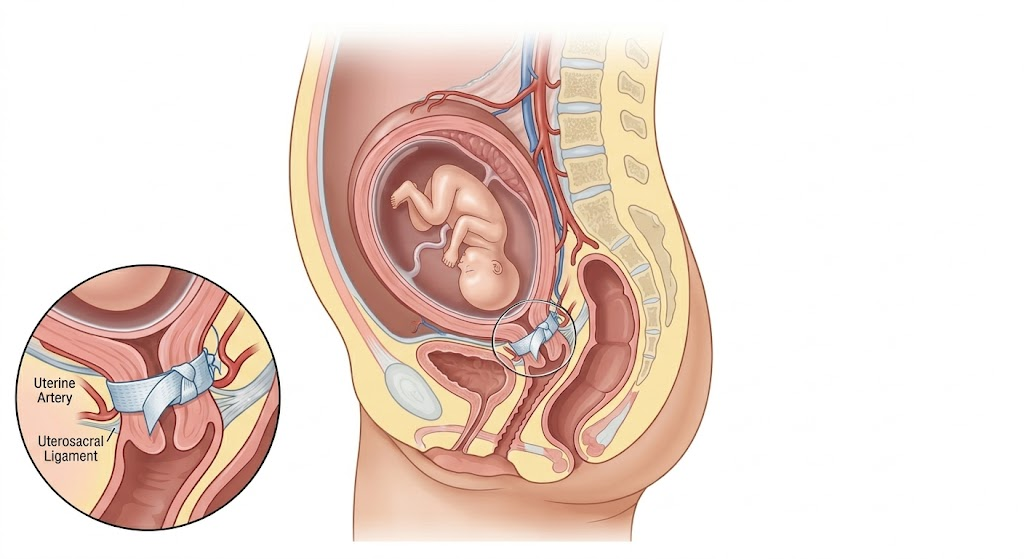
What Is Abdominal Cerclage?
A cerclage is a stitch placed around the cervix to keep it closed during pregnancy. The cervix is the lower part of the uterus, and in some women, it opens too early, long before the baby is ready, leading to second-trimester loss or extreme preterm birth.
Most cerclages are placed vaginally (transvaginal cerclage), through the birth canal, usually between 12 and 16 weeks of pregnancy. For most women with cervical incompetence, a vaginal cerclage works well.
Abdominal cerclage, also called transabdominal cerclage (TAC), is different. The stitch is placed much higher, at the top of the cervix (the cervicoisthmic junction), through the abdomen rather than the vagina. This gives it a far stronger anchor than any vaginal approach can provide.
It is either placed laparoscopically (keyhole surgery, two or three small cuts in the abdomen) or through open surgery, depending on individual anatomy and surgical history.
Who Actually Needs an Abdominal Cerclage?
This is not a routine procedure. It is specifically for women where a vaginal cerclage is not possible or has already failed. Your doctor would consider it if:
- You have had one or more second-trimester pregnancy losses due to cervical incompetence
- A previous vaginal cerclage failed, and you lost the pregnancy despite it
- Your cervix is too short, too damaged, or too scarred for a vaginal stitch to hold
- You have a congenitally short cervix with almost no cervical tissue available vaginally
- You have had a previous trachelectomy (surgical removal of part of the cervix, often for cervical cancer)
- Ultrasound shows very early and severe cervical shortening in a current or previous pregnancy
Not every woman with cervical shortening needs this procedure. But for women in the categories above, it offers protection that a vaginal cerclage simply cannot.
When Is It Placed?
Abdominal cerclage can be placed in two ways:
Before pregnancy (interval TAC): This is the preferred approach for women who have already had a failed vaginal cerclage or multiple losses. The stitch is placed between pregnancies — during a laparoscopic procedure — and stays permanently in place. When pregnancy happens, the stitch is already there.
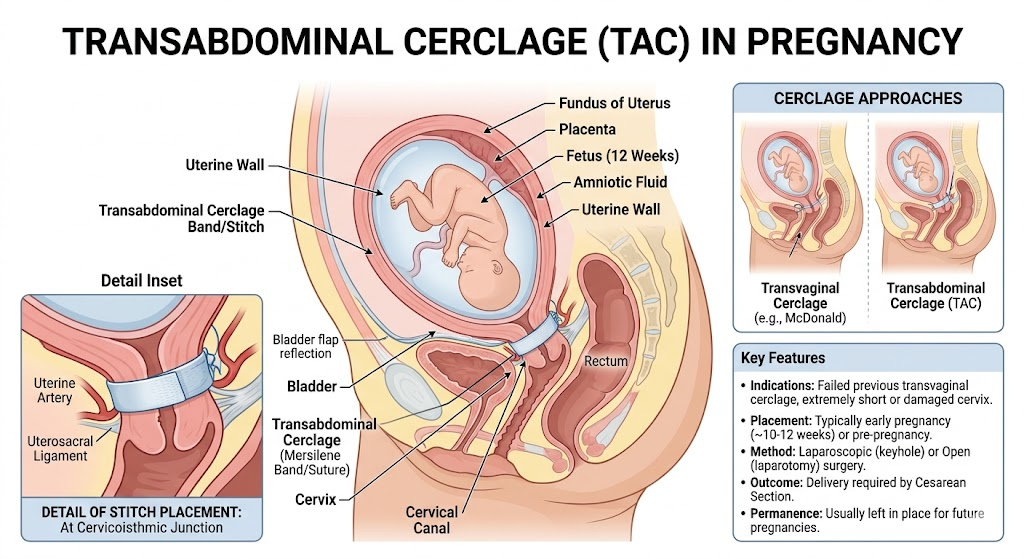
During early pregnancy: If the procedure was not done before conception, it can be placed during the first trimester (usually before 14 weeks), when the uterus is still small enough to allow safe surgical access.
“I almost always recommend placing the stitch before pregnancy if a woman has had a previous cerclage failure. Waiting until after conception adds risk. When it is in place before she conceives, she can go into that pregnancy with one fewer thing to worry about.”
— Dr. Manisha Mehta
What Happens During Delivery?
This is an important question. Because the abdominal stitch sits at the top of the cervix and cannot be removed vaginally, all births after a transabdominal cerclage must be by caesarean section. The stitch itself is usually left in place after delivery, so it can support future pregnancies as well.
This is something every woman considering the procedure needs to understand clearly before going ahead.
Abdominal Cerclage in Haryana by Dr. Manisha Mehta
Transabdominal cerclage is a highly specialised procedure. Very few centres in North India perform it regularly, and in the states of Haryana, Punjab, and Rajasthan, Dr. Manisha Mehta at Apex Hospital, Sirsa is currently the only surgeon offering abdominal cerclage to patients. Women who have experienced repeated second-trimester losses or failed vaginal cerclages from across this region now have access to this procedure without travelling to Delhi or other metro cities.
If you have been told that your cervix cannot hold a pregnancy, or that a standard vaginal stitch will not work for you, this may be the option that changes your outcome.
Dr. Mehta sees patients from Sirsa, Hisar, Fatehabad, Chandigarh, Bathinda, Jaipur, and across the Delhi NCR. Online consultations are also available for women who want to understand whether they are a candidate before travelling.

Frequently Asked Questions
1. What is the difference between abdominal cerclage and vaginal cerclage?
A vaginal cerclage is placed through the birth canal, lower on the cervix. An abdominal cerclage is placed higher — at the cervicoisthmic junction — through the abdomen, and provides a much stronger hold. It is used when vaginal cerclage is not possible or has previously failed.
2. Can I have a normal delivery after abdominal cerclage?
No. Because the stitch is placed abdominally and cannot be removed vaginally, all deliveries after a TAC must be by caesarean section. The stitch is typically left in place for future pregnancies.
3. Is abdominal cerclage done by keyhole surgery?
In most cases, yes. Laparoscopic (keyhole) surgery is the preferred approach — it means a faster recovery, less pain, and smaller scars. Open surgery is occasionally needed depending on anatomy or surgical history.
4. When should abdominal cerclage be placed — before or during pregnancy?
Ideally before. Placing the stitch between pregnancies (interval TAC) is safer and more controlled than operating during early pregnancy. If you have had a previous cerclage failure or loss, speak to a specialist before your next conception attempt.
5. Who is the best doctor for abdominal cerclage in Haryana?
Dr. Manisha Mehta at Apex Hospital, Sirsa, is currently the only doctor performing abdominal cerclage in Haryana, Punjab, and Rajasthan. She specialises in complex obstetric and fertility cases and has over 20 years of experience managing high-risk pregnancies.