

If you’ve been managing PCOS, or you’ve just been diagnosed, you may have seen something confusing pop up in the news recently. The condition has a new name. And if you’re wondering whether your diagnosis still stands or whether something about your body has changed, you’re not the only one asking.
Here’s the short answer. In May 2026, PCOS (Polycystic Ovary Syndrome) was officially renamed PMOS — Polyendocrine Metabolic Ovarian Syndrome. The decision came out of a global consensus published in The Lancet, backed by more than 50 medical and patient organisations, including ASRM and the Endocrine Society. Your diagnosis hasn’t changed. Your body hasn’t changed. The name finally caught up to what doctors have understood for years: this was never just about the ovaries.
“I’ve spent two decades treating women who were told their ultrasound looked normal, so they couldn’t possibly have PCOS. That always frustrated me, because the ovaries are only one piece of this. The new name reflects what I see in clinic every single day,” says Dr. Manisha Mehta, a leading IVF doctor in India with over 20 years of experience in reproductive medicine.
What Is PMOS?
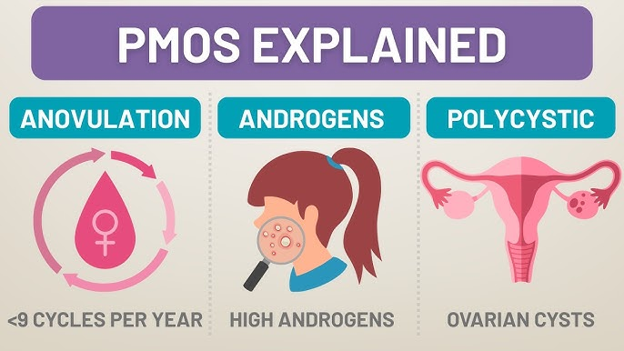
PMOS, or Polyendocrine Metabolic Ovarian Syndrome, is the new medical name for what was previously called PCOS. It’s a long-term hormonal condition where the body’s endocrine and metabolic systems are out of balance, often driven by insulin resistance and higher-than-usual levels of male hormones like testosterone. It affects roughly 1 in 8 women worldwide. The ovaries are involved, yes, but they’re not the whole story, and the new name says so plainly.
Still a little unsure what this means for your own health? That’s completely normal, and it’s worth talking through with someone who treats this every day.
Why Did the Name Change?
The old name was, frankly, misleading. And it caused real harm over the years.
The word “polycystic” pointed everyone toward cysts on the ovaries. But here’s the thing most people don’t know: those aren’t actually cysts. They’re immature follicles, and not every woman with the condition even has them. So when a woman walked in with irregular periods, weight changes, acne, or trouble conceiving, but her ovaries looked clear on a scan, she was often told she didn’t have PCOS. She was sent home. The real problem went unaddressed.
The new name fixes that framing:
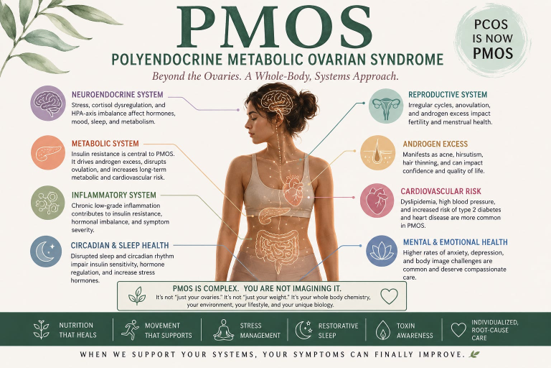
- “Polyendocrine” signals that several hormone systems are involved, not just one.
- “Metabolic” brings in the link to insulin resistance, weight, blood sugar, and long-term risks like type 2 diabetes and heart disease.
- “Ovarian” keeps the reproductive connection, because that part is still real and still matters.
It took over a decade of work, surveys with 22,000 people, and dozens of medical bodies agreeing to get here. This wasn’t a marketing decision. It was a correction.
What’s Actually Different With PMOS?
This is where it helps to be clear, because the headlines can make it sound bigger than it is.
The name changed. The condition did not.
- Your diagnosis stays the same. If you were diagnosed with PCOS last year, you have PMOS now. Same condition, new label.
- Diagnostic criteria haven’t changed. Doctors still look at the same things: your hormone levels, your cycle history, ovarian appearance on ultrasound.
- Treatment is the same. The medications, the lifestyle approaches, the fertility protocols, all of it carries over. Nothing you’re currently doing becomes wrong overnight.
- The mindset around it should shift, though. That’s the real win. A name that includes “metabolic” tells your doctor to screen for blood sugar issues, cholesterol, and heart health, not just write a prescription and move on.
So if you don’t change a single thing about your treatment tomorrow, that’s completely fine.
“What I hope changes isn’t the prescription. It’s how seriously the whole condition gets taken, by patients and doctors alike,” says Dr. Manisha Mehta.
Living with this a while? Make sure you’re being treated as a whole, not just your ovaries.
What This Means If You’re Trying to Conceive
For women dealing with fertility challenges, this rename matters more than it might first appear.
PMOS is one of the most common reasons behind irregular ovulation and difficulty getting pregnant. When the condition is treated as a whole-body issue rather than an ovary-only one, the fertility picture often becomes clearer. Managing insulin resistance, supporting a healthy weight, and balancing hormones can all improve your odds, sometimes before any advanced treatment is even needed.
And when fertility treatment does become the right path, knowing the full metabolic picture helps a great deal. Whether it’s ovulation induction, IUI treatment, or IVF, a plan that accounts for your hormones and your metabolism tends to work better than one that ignores half of what’s going on.
Patients often describe Dr. Mehta as warm, patient, and genuinely thorough, the kind of doctor who explains the why behind every step. As a member of ASRM, ESHRE, and FOGSI, and with an 85% IVF success rate, she brings both global expertise and a deeply personal approach to women navigating conditions like PMOS.

Frequently Asked Questions
Is PMOS the same as PCOS?
Yes. PMOS (Polyendocrine Metabolic Ovarian Syndrome) is simply the new official name for PCOS. The condition itself is identical; only the terminology has changed to better reflect its hormonal and metabolic nature.
Do I need to get re-diagnosed now that PCOS is called PMOS?
No. If you’ve already been diagnosed with PCOS, that diagnosis still holds. You don’t need new tests or a fresh diagnosis simply because the name changed.
Why was PCOS renamed to PMOS?
The old name overemphasised ovarian cysts, which many patients don’t even have, leading to missed diagnoses. The new name highlights the condition’s hormonal (polyendocrine) and metabolic dimensions for more accurate care.
Does the name change affect PMOS treatment or fertility options?
Treatment protocols remain the same. What may improve is screening, since the new name encourages doctors to check metabolic health too, which can support better fertility and long-term outcomes.
Can women with PMOS still get pregnant?
Absolutely. Many women with PMOS conceive, whether naturally or with support like ovulation induction, IUI, or IVF. A treatment plan that addresses both hormones and metabolism often improves the chances.
References
- The Lancet — Polyendocrine metabolic ovarian syndrome, the new name for polycystic ovary syndrome: a multistep global consensus process https://www.thelancet.com/journals/lancet/article/PIIS0140-6736(26)00717-8/fulltext
- American Society for Reproductive Medicine (ASRM) — PCOS is Now PMOS: Understanding the Name Change https://www.asrm.org/news-and-events/asrm-news/latest-news/may-27-2026-pcos-is-now-pmos-understanding-the-name-change/

