

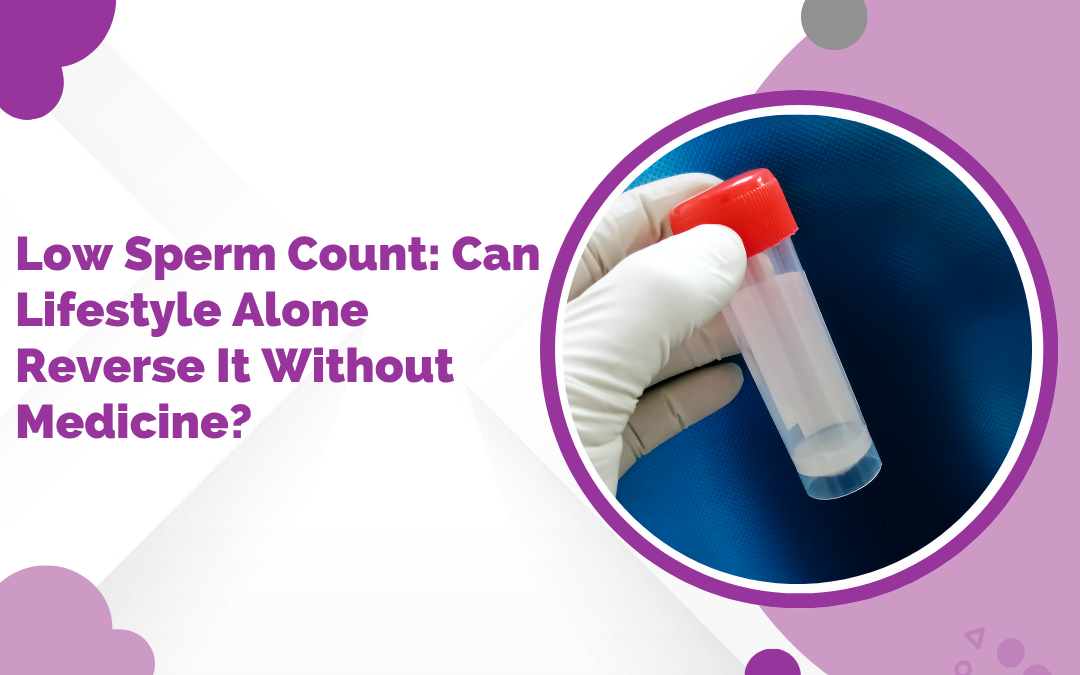
Lifestyle changes alone can reverse mild oligospermia in men whose sperm count dropped due to smoking, heat exposure, poor diet, obesity, or stress, because sperm regenerates every 74 days and the count measured on a semen analysis today reflects the conditions the body was under 3 months ago rather than the conditions it is under right now. Severe oligospermia below 5 million per mL, genetic causes like Y chromosome microdeletions, and structural problems like varicocele typically cannot be fixed by lifestyle alone and need medical or surgical intervention alongside whatever changes the man makes at home.
According to Dr. Manisha Mehta, IVF Doctor in India, “The conversation about male lifestyle changes is one of the hardest in fertility practice because the husband sitting across from me often does not believe his sperm count has anything to do with the fact that he smokes a pack a day, drinks every weekend, sleeps 5 hours a night, and keeps his laptop on his thighs for 8 hours at his IT job, and getting him to accept that his report card is a reflection of his last 3 months of living is a negotiation that sometimes takes longer than the treatment itself.”
Which Lifestyle Factors Actually Move the Numbers on a Semen Analysis?
Most fertility blogs list 10 lifestyle tips for sperm health as if each one carries equal weight, when in clinical practice some changes produce measurable differences on the next semen analysis while others make the patient feel virtuous without actually moving the count, and the men who waste 3 months on the changes that do not matter while continuing the habits that do are the ones whose repeat analysis comes back looking exactly like the first one.
- Quit smoking and the count responds within one cycle: Smoking reduces sperm count, motility, and morphology simultaneously while causing DNA fragmentation that standard semen analysis does not even measure, and research on sperm nicotinic receptors shows that chronic nicotine exposure directly reduces the sperm’s ability to bind to the egg at the molecular level, which is why men who quit smoking and come back 3 months later frequently show improvement across every parameter on the report without changing anything else about their lifestyle.
- Heat is the silent saboteur nobody takes seriously: Laptops resting on thighs for 8 hours a day at work, tight underwear compressing the scrotum against the body, prolonged sitting without breaks, hot water baths every evening, and the men who commute 2 hours daily on a heated motorcycle seat are all raising testicular temperature above the 2 degrees below body temperature that sperm production requires, and switching to boxers, using a desk for the laptop, and taking standing breaks every 90 minutes produces measurable improvement within one spermatogenesis cycle for patients whose heat exposure was the primary factor.
- Sleep deprivation suppresses the hormones sperm needs: Men who sleep 7 to 8 hours have a 42 percent higher probability of conception than men sleeping less, because testosterone production peaks during deep sleep and men who consistently get 5 or 6 hours are producing sperm under chronically suboptimal hormonal conditions, and the Indian IT professional working until midnight and waking at 6 AM for a standup call is running a fertility deficit he does not realise exists until the semen analysis quantifies what his body has been telling him for months.
- Gym supplements doing the opposite of what men expect: Testosterone boosters, anabolic steroids, and prohormone supplements marketed for muscle building shut down the body’s natural testosterone production through negative feedback on the pituitary gland, and the man who started taking testosterone because he thought it would help his fertility is often the one presenting with the lowest sperm count in the entire clinic, because exogenous testosterone tells the brain to stop signalling the testes to produce their own, and sperm production collapses as a direct result of the supplement that was supposed to make him more virile.
Women whose partners have low counts preparing for IVF treatment in India should know that 3 months of targeted male lifestyle changes before the cycle can produce a meaningfully better semen sample for ICSI than starting the cycle immediately with the current report.
When Is Lifestyle Not Enough and Medical Help Becomes Necessary?
The men whose semen analysis improves dramatically with lifestyle changes are almost always the ones whose count was mild to moderately low and whose habits contained an obvious culprit that could be removed, and the men whose count stays the same despite doing everything right for 3 months usually have an underlying medical or structural cause that willpower and discipline cannot fix regardless of how committed the patient is.
- Below 5 million per mL rarely responds to lifestyle alone: Severe oligospermia at this level typically has a hormonal, genetic, or structural origin that lifestyle modification cannot address, and the couples who spend 6 months waiting for diet and supplements to fix a count that needed medical workup from day one are losing time that matters more for the woman’s fertility than for the man’s, because her egg quality declines with every passing month while he experiments with zinc tablets and pomegranate juice.
- Varicocele needs a clinical decision not a lifestyle change: An enlarged vein in the scrotum raising testicular temperature is the most common finding in men with low sperm count, and no amount of boxer shorts or cold compresses will fix the haemodynamic problem that a varicocele creates, and patients whose urologist identified a grade 2 or 3 varicocele on examination should be having the surgical repair conversation rather than spending another 3 months hoping that lifestyle changes will compensate for a structural problem that produces heat the body cannot regulate away.
- Testosterone supplements need to be stopped immediately: Men who are taking exogenous testosterone and presenting with azoospermia or severe oligospermia need to discontinue under medical supervision and wait 3 to 6 months for the pituitary-testicular axis to recover, and some men’s sperm production never fully returns to pre-supplement levels, making this one of the most preventable causes of male infertility and one of the most frustrating to treat because the damage was self-inflicted by a supplement the patient bought specifically to feel more masculine.
- Partner’s age determines how long you can wait: A 28-year-old couple where the husband has mild oligospermia can afford 3 to 6 months of lifestyle optimisation before escalating to IUI treatment or IVF, but a 37-year-old couple with the same male diagnosis cannot afford the same timeline because the wife’s egg quality decline does not pause while the husband’s sperm count recovers, and the clinical decision about how long to try lifestyle changes must factor in her reproductive clock alongside his semen parameters.
Male factor accounts for 40 to 50 percent of all infertility cases and yet the husband is almost always the last person in an Indian family to get tested, and women managing Lifestyle changes alongside a partner with low sperm count face a situation where both sides of the equation need attention simultaneously rather than sequentially. Any good IVF center in India evaluates both partners from the first consultation and builds the male lifestyle protocol into the same timeline as the female treatment plan rather than treating the husband’s sperm as an afterthought to the wife’s ovaries.
Why Choose Dr. Manisha Mehta?
Dr. Manisha Mehta has spent 20 years treating couples where the male factor was contributing to the problem and the husband did not believe it until the semen analysis landed on the table, and her 85% IVF success rate includes couples whose repeat analysis after 3 months of targeted lifestyle intervention produced a sample good enough to change the treatment plan from IVF-ICSI to IUI, saving lakhs in the process. Recognised among the best IVF specialists in India for evaluating both partners with equal clinical rigour from the first appointment, she builds male lifestyle protocols into every treatment timeline rather than addressing sperm only after the female workup is complete.
Call Now: +91 91680 39000
Concerned about sperm count and unsure whether lifestyle changes are enough for your situation? Get a semen analysis with clinical interpretation that tells you exactly what needs to change and how long to give it before considering medical intervention.
Frequently Asked Questions
How long does it take for lifestyle changes to improve sperm count?
Sperm takes approximately 74 days to mature, so any lifestyle change made today will show results on a semen analysis approximately 3 months later, not sooner.
Can quitting smoking alone improve sperm count?
Quitting smoking improves count, motility, morphology, and DNA integrity simultaneously, and for men whose primary modifiable risk factor is smoking, this single change can produce significant improvement within one spermatogenesis cycle.
Do testosterone supplements help or hurt male fertility?
Exogenous testosterone shuts down the body’s own production through pituitary feedback and can cause severe oligospermia or azoospermia, making testosterone supplementation one of the most counterintuitive and preventable causes of male infertility.
When should a couple stop trying lifestyle changes and start medical treatment?
If lifestyle optimisation for 3 months produces no improvement on repeat semen analysis, or if the count is below 5 million per mL from the start, medical evaluation for hormonal, genetic, or structural causes should not be delayed further.
You deserve answers from a doctor who knows your case.
Whether you are worried about a symptom, overdue for a check-up
I am here, and I am listening.
Talk to Dr. Manisha Mehta. Book Your Consultation Today.
Medically Reviewed by

Dr. Manisha Mehta
Gynaecologist & Obstetrics Specialist,IVF Doctor in India
Specialisation: Minimally Invasive Gynaecological Surgery | Women’s Health | Post-Operative CareApex Hospital -Sirsa, Haryana | Serving Delhi NCR, Haryana & surrounding regions
Reference link:
- Lifestyle Factors and Male Fertility – National Institutes of Health
- WHO Laboratory Manual for Semen Analysis, 6th Edition – World Health Organization

