
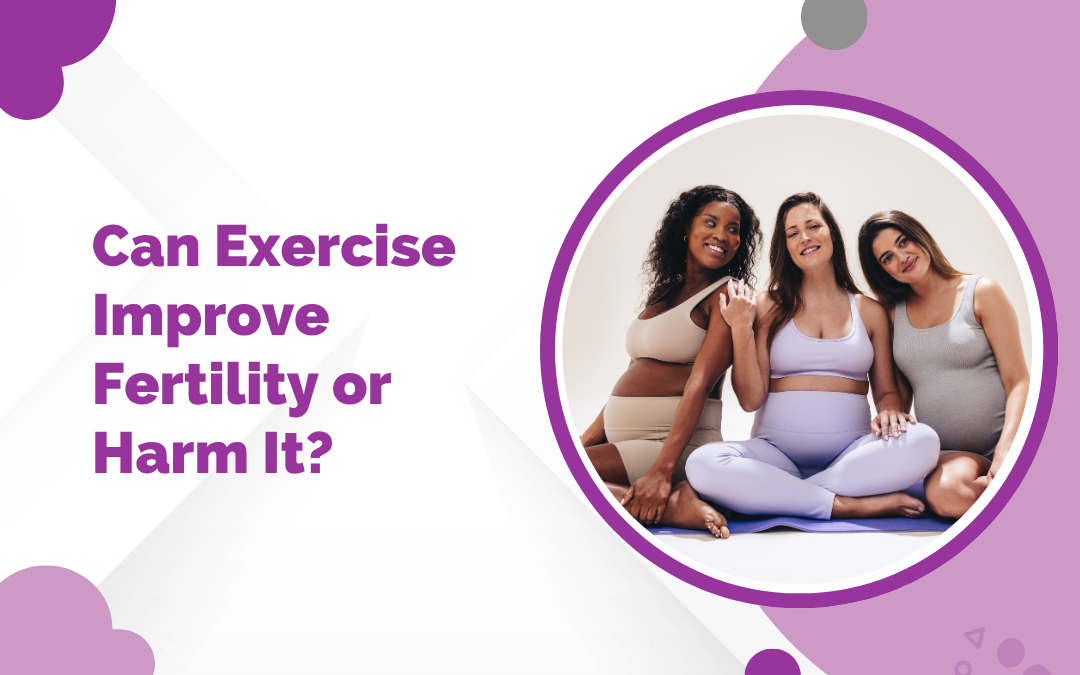
Moderate exercise of 30 to 60 minutes daily improves fertility by regulating hormones, reducing insulin resistance, lowering stress, and supporting ovulation in women while improving sperm quality in men. Intense exercise exceeding one hour daily or high-impact training like marathon running and aggressive HIIT can spike cortisol, suppress reproductive hormones, and disrupt ovulation, making the type and intensity of movement as important as movement itself.
According to Dr. Manisha Mehta, IVF Doctor in India, “The patients who walk into my clinic after months of aggressive gym routines expecting faster conception are often the ones whose cycles have become more irregular, and the conversation about dialling exercise back is one of the hardest ones to have because they are convinced more effort should mean better results.”
How Does the Right Kind of Exercise Improve Fertility?
Most fertility patients think exercise is either good or bad, but the reality is that thirty minutes of walking after dinner helps while two hours of CrossFit on an empty stomach does the opposite, and the distance between those two is smaller than anyone expects when they first start trying to conceive.
- Insulin and ovulation: PCOS patients who started walking daily or lifting weights three times a week showed different LH-to-FSH ratios within two to three months without any medication change, just consistent moderate movement that improved insulin sensitivity enough for the ovaries to wake up on their own, and the fact that something this simple works this well is probably the most underappreciated finding in fertility medicine right now.
- Stress and cortisol: One couple swapped their evening Netflix habit for a 30-minute walk together and came back reporting better cycle regularity alongside lower anxiety at monitoring appointments, which is the kind of outcome that never makes it into a clinical trial but keeps showing up in the consultation room often enough that dismissing it as anecdotal feels dishonest.
- Weight and hormones: Body fat produces estrogen and too much of it throws ovulation off, but losing even 5 to 10 percent of body weight through moderate exercise restarts ovulation in a significant percentage of anovulatory patients without any pharmaceutical intervention, making it the cheapest and most underused fertility treatment available in a field where everything else costs lakhs.
- Male fertility: Men exercising 3 to 5 times weekly had measurably better semen parameters in published research, and considering male factor accounts for half of all infertility cases the husband sitting in the waiting room scrolling Instagram reels while his wife undergoes every test and procedure alone is a pattern that fertility clinics across India see far too often and rarely confront directly enough.
Women preparing for IVF treatment in India who build moderate exercise into their preconception months show better ovarian response to stimulation than women who remain sedentary throughout.
When Does Exercise Start Harming Fertility Instead of Helping?
The patients whose exercise habits are working against their fertility almost never suspect it because the same discipline that gets them to the gym at 6 AM every morning is the exact personality trait that makes them resistant to hearing they need to do less, and this particular conversation between doctor and patient goes sideways more often than it should.
- Excessive training: Running 10 kilometres daily, back-to-back HIIT classes, CrossFit five days a week, these routines push cortisol high enough to shut down ovulation entirely, and the women presenting with hypothalamic amenorrhoea at fertility clinics are increasingly the fit and disciplined patients rather than the ones anyone in the waiting room would guess have a reproductive problem, which is what makes this diagnosis so counterintuitive and so frequently missed.
- Energy deficit: The body reads a sustained calorie deficit as famine and shuts down reproduction first because pregnancy during starvation is biologically dangerous, and the patients counting macros while training twice daily are consistently the hardest to convince that eating more and moving less is genuinely the medical prescription rather than the doctor being lazy with advice.
- Cortisol compounding: PCOS already elevates cortisol on its own, and stacking aggressive exercise on top creates a double hit that worsens insulin resistance and androgen levels at the same time, which is why patients going through IUI treatment are told to keep movement moderate during their cycle rather than using the treatment period as extra motivation to push harder at the gym.
- Male overtraining: Cycling more than 5 hours weekly and heavy squatting without adequate recovery days reduce testosterone and increase scrotal temperature enough to lower sperm production measurably, and men preparing for fertility treatment who flatly refuse to scale back their training are often the same ones whose semen analysis comes back unchanged cycle after cycle despite every other variable in the protocol being optimised around them.
Women managing PCOS and weight loss alongside fertility need exercise that serves both goals without triggering the cortisol response that actively makes both worse. Any good IVF center in India now treats exercise guidance as part of the preconception protocol rather than something the patient should figure out from YouTube.
Why Choose Dr. Manisha Mehta?
Dr. Manisha Mehta has spent 20 years watching patients train their way out of ovulation and then wonder why their cycles disappeared, which is why she assesses exercise habits with the same clinical seriousness as hormone levels and ultrasound findings, and her 85% IVF success rate reflects a protocol that treats lifestyle as medicine rather than as a footnote. Recognised among the best IVF specialists in India for building exercise prescription into fertility care, she designs movement recommendations around each patient’s hormonal profile rather than handing out the same generic walking advice to everyone.
Call Now: +91 91680 39000
👉 Trying to conceive and unsure whether your exercise routine is helping or hurting? Get a personalised assessment that aligns your movement habits with your fertility goals.
Frequently Asked Questions
What is the best exercise for fertility?
Walking 30 minutes daily and strength training 2 to 3 times weekly improves insulin sensitivity and hormonal balance without spiking cortisol.
Can too much exercise stop ovulation?
Intense training exceeding one hour daily can suppress GnRH pulses and cause hypothalamic amenorrhoea where ovulation stops entirely.
Should I exercise during IVF treatment?
Light walking and gentle yoga are generally safe during stimulation and after transfer, but intense workouts should be paused during active treatment cycles.
Does exercise improve male fertility too?
Moderate exercise 3 to 5 times weekly improves testosterone, sperm count, motility, and morphology, but overtraining and cycling reduce sperm production.
You deserve answers from a doctor who knows your case.
Whether you are worried about a symptom, overdue for a check-up
I am here, and I am listening.
Talk to Dr. Manisha Mehta. Book Your Consultation Today.
Medically Reviewed by

Dr. Manisha Mehta
Gynaecologist & Obstetrics Specialist,IVF Doctor in India
Specialisation: Minimally Invasive Gynaecological Surgery | Women’s Health | Post-Operative CareApex Hospital -Sirsa, Haryana | Serving Delhi NCR, Haryana & surrounding regions
Reference link:
- History of in vitro fertilization in India
https://www.ncbi.nlm.nih.gov/pmc/articles/PMC3657976/ - Assisted reproductive technology in India: current scenario
https://pubmed.ncbi.nlm.nih.gov/30386559/

v57tue
pu2rbc
H2 Poker… I love the environment and I love the way these guys run the tourneys, very professional! I’m heading on down this weekend. See ya there! h2 poker
SlotsPH8! Love hitting up the slots. Gonna give this one a spin and see if I can hit it big! slotsph8
82 Bet, huh? Let’s see what kinda action we got here! Always down for a little gamble. 82 bet
Solid experience so far. The loading times are short and the gameplay is fluid. Definitely my new go-to spot bdacc444