

Egg Freezing in India (Oocyte Cryopreservation)
Egg freezing, medically known as oocyte cryopreservation, is a fertility preservation procedure where a woman’s eggs are retrieved, frozen using vitrification, and stored for future use. In India, it is most commonly chosen by women in their late 20s to mid 30s, by cancer patients before chemotherapy, and by women who want to protect their fertility without the pressure of timing pregnancy around other life plans. The cost in India is significantly lower than in most countries, and outcomes are best when eggs are frozen before the age of 35.
Dr. Manisha Mehta, a leading IVF doctor in India is known for her expertise in fertility preservation and complex IVF cases. Whether you’re considering egg freezing for medical reasons, planning ahead, or advised to freeze eggs before cancer treatment, she follows an individualised approach based on your age, ovarian reserve, and future plans.
“Egg freezing isn’t just a medical procedure, it’s a decision about the future. My role is to give patients honest data about their own ovarian reserve so they can make that decision with full clarity, not guesswork,” says Dr. Manisha Mehta.
Thinking about preserving your fertility? Connect with Dr. Manisha Mehta to understand what egg freezing can mean for you.
Who Should Consider Egg Freezing?
Egg freezing is not for every woman, but for certain situations, it is a genuinely useful option. It is typically considered if:
You're in your late 20s to early 30s and prioritising career or education - freezing eggs at this age protects the quality you have now, before natural decline begins.
You have PCOS or low ovarian reserve (low AMH) - women with declining egg numbers benefit from freezing sooner rather than later, while eggs are still available.
You're undergoing cancer treatment - chemotherapy and radiation can damage ovarian function permanently, and egg freezing before treatment preserves the option of biological children later.
You don't have a current partner but want the option of motherhood later - freezing eggs keeps that option open without the pressure of finding the right partner on a timeline.
You have a family history of early menopause - if your mother or sister entered menopause early, your ovarian reserve may decline earlier than expected, and preservation is worth discussing.
You're planning medical procedures that affect the ovaries - including surgery for endometriosis or ovarian cysts.
Not sure if egg freezing fits your situation? A one-on-one consultation with Dr. Mehta will give you clarity based on your actual hormone levels and ovarian reserve.
The egg freezing process — step by step
The egg freezing process is structured, medically supervised, and typically completed within 2–3 weeks.
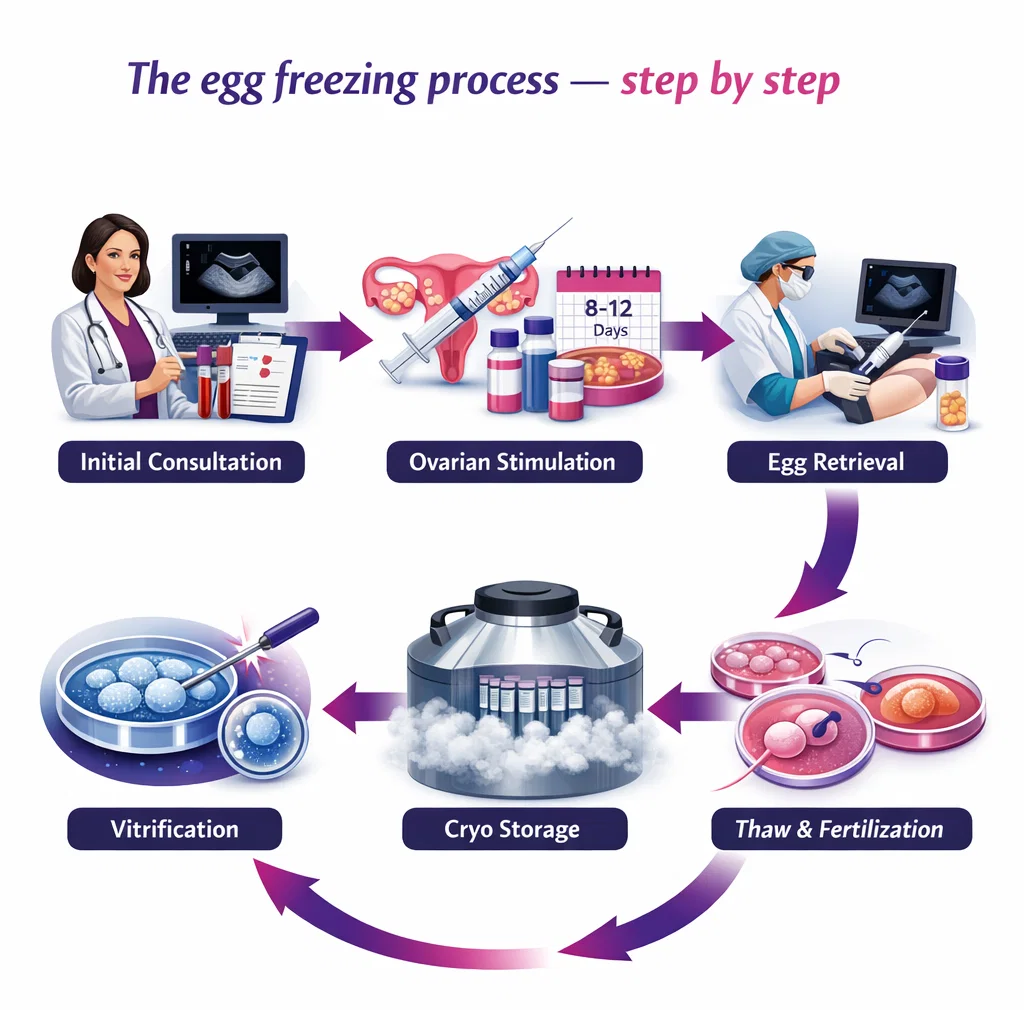
Initial consultation and hormone testing
Blood tests and ultrasound scans are done to evaluate ovarian reserve and hormone levels. This helps personalise the treatment plan.
Ovarian stimulation (8–12 days)
Hormonal injections are given to stimulate the ovaries to produce multiple eggs. Regular monitoring ensures safe and effective response.
Egg retrieval (transvaginal ultrasound-guided)
A minor procedure performed under sedation where mature eggs are collected using ultrasound guidance. It usually takes 15–20 minutes.
Vitrification (flash freezing)
Retrieved eggs are rapidly frozen using vitrification, a technique that prevents ice crystal formation and preserves egg quality.
Storage in liquid nitrogen
Frozen eggs are stored at extremely low temperatures in specialised tanks, maintaining their viability for years.
Thawing and fertilisation when ready
When you decide to use the eggs, they are thawed and fertilised using IVF techniques.
Egg Freezing Cost in India
Egg freezing involves multiple steps, including testing, stimulation, retrieval, and storage. Instead of focusing on a fixed number, it is more practical to understand that the cost depends on your medical profile, medication needs, and the number of cycles required.
The most accurate way to understand your expected cost is through a personalised consultation, where the doctor can assess your ovarian reserve and recommend a tailored plan.
Speak to our fertility specialist to get a personalised treatment and cost plan.
Egg Freezing Success Rates — What to Realistically Expect
Success with frozen eggs depends on two things: the age at which the eggs were frozen, and the number of mature eggs retrieved. Younger eggs are healthier, and more eggs mean more chances per thaw cycle.
| Age at Freezing | Expected Outcome |
| Under 35 | Best outcomes with higher implantation potential |
| 35–37 | Good outcomes, but slightly reduced compared to younger age |
| 38–40 | Reduced success, but still beneficial |
| Above 40 | Lower success rates require detailed counselling |
With modern vitrification techniques, egg survival rates after thawing are above 90% in leading fertility centres.
It is also important to note that having more eggs stored increases the chances of future pregnancy. Your doctor will provide personalised success estimates based on your reports.
Is Egg Freezing Safe? Risks and Side Effects
Egg freezing is considered a low-risk procedure, but like any medical treatment, it is not entirely risk-free. The most common side effects are mild and temporary, such as bloating or discomfort during ovarian stimulation.
A rare complication is ovarian hyperstimulation syndrome (OHSS), where the ovaries respond excessively to hormones. With modern protocols and careful monitoring, this risk is significantly reduced.
The egg retrieval procedure is minimally invasive and performed under sedation, making it generally well tolerated.
Frozen eggs can remain viable for 10 years or more when stored in controlled liquid nitrogen environments, without compromising quality.
Why choose Dr. Manisha Mehta for egg freezing in India?

Choosing the right fertility specialist plays a key role in outcomes.
- Extensive experience in fertility preservation and IVF treatments
- Advanced vitrification protocols ensuring high egg survival rates
- State-of-the-art embryology lab maintaining strict quality standards
- Individualised treatment plans based on patient-specific fertility assessment
Dr. Manisha Mehta follows a patient-first approach, ensuring clarity and transparency at every stage.
“Egg freezing is not about urgency—it is about timing it correctly based on your biology, not assumptions,” says Dr. Mehta.
Watch this video where she explains the science behind egg freezing, the step-by-step process, common misconceptions, and what women should realistically expect before making a decision.
https://youtu.be/4Qj0IWmTkLc?si=FzZv1C-w2ebdHZFI
Her approach focuses on giving patients realistic expectations while maximising their chances through careful planning.
Schedule your consultation to discuss if egg freezing is the right step for you.
Want more fertility insights? Connect with us on social media for expert tips and patient stories.

For over 25 years, Dr. Manisha Mehta and Dr. R.K. Mehta of Apex Hospital have helped couples experience the joy of parenthood through advanced fertility care and trusted medical guidance. Through The Fertility Couple, they reach millions every month, with educational videos that receive over 3 million YouTube views on average, helping people better understand fertility, reproductive health, and treatment options.
Stay connected with The Fertility Couple on Youtube:
FAQs
Starting IVF?
Here Are the Answers
You’re Looking For
Curious About IVF? Let’s Talk.

Mail Us
apexmedia2001@gmail.com

Call Now
9619642000
What is the ideal age for egg freezing in India?
The ideal age is typically between 28 and 35 years, when egg quality and quantity are better. However, this can vary depending on individual ovarian reserve and health. A fertility assessment helps determine the right timing for each person.
How many eggs should I freeze?
Most specialists recommend freezing 10–20 eggs for a reasonable chance of future pregnancy. The exact number depends on your age and ovarian response. Some women may require more than one cycle to achieve this number.
Does egg freezing affect future fertility?
Egg freezing does not negatively impact natural fertility. It preserves existing eggs but does not reduce your chances of conceiving naturally later. It acts as a backup option rather than replacing natural fertility.
Is egg freezing covered by insurance in India?
In most cases, egg freezing is not covered under standard health insurance policies. Some exceptions may exist for medical indications like cancer treatment, but this depends on the insurer.
What is the difference between egg freezing and embryo freezing?
Egg freezing stores unfertilised eggs, while embryo freezing involves fertilising eggs with sperm before freezing. Egg freezing is preferred when a woman does not have or does not want to use a partner’s sperm at the time.
How painful is the egg retrieval process?
The procedure is done under sedation, so you will not feel pain during retrieval. Mild discomfort or cramping may occur afterwards, but it usually resolves within a day or two.
Can I freeze eggs if I have PCOS?
Yes, women with PCOS can freeze eggs. In fact, early preservation may be beneficial. However, careful monitoring is required to avoid overstimulation, and treatment is customised accordingly.
How do I know if egg freezing is right for me?
A fertility evaluation including hormone tests and ultrasound can help determine your ovarian reserve and reproductive timeline. Based on this, your doctor can advise whether egg freezing is appropriate.
What happens to my frozen eggs if I never use them?
If you choose not to use your eggs, you may continue storage, donate them for research (where permitted), or discard them based on your consent and clinic policies.
